

Urinary Incontinence Treatment in Houston, TX
Men’s Health Specialist – Dr. Jonathan Clavell
According to WebMD, millions of men experience incontinence, often as a result of diabetes or prostate surgery. Incontinence can limit activities, keep men homebound, and subject them to costly, messy pads. This is in addition to dealing with the frustration related to incontinence. The reality is, men don’t have to live with bladder control problems anymore. Health.com, in their blog about incontinence for males, mentioned 14 very important facts to be considered when facing urinary incontinence.
Dr. Jonathan Clavell is a board-certified urologist and men’s health specialist in Houston, TX, who is an expert in treating men experiencing mild, moderate, and severe incontinence. Learn more about male incontinence and call (713) 424-4030 to schedule your consultation with Dr. Clavell today.
What is Male Urinary Incontinence?
It’s a taboo subject – no one wants to talk about incontinence. The fact is, the myths of incontinence often obstruct people from getting the help they need to live an active lifestyle. Knowing the truth about incontinence can help relieve any embarrassment of the condition.
Over 2 million men suffer from incontinence. You are not alone.
Bladder (or urinary) incontinence is the unintentional loss of urine. It is a serious problem that men are reluctant to discuss with others. When the muscle (sphincter) that holds the bladder neck closed is not strong enough to retain urine in the bladder, the result is urinary incontinence.
Incontinence may occur when:
- The sphincter is too weak
- The bladder muscles contract strongly
- The bladder is not emptied regularly
In men, urinary incontinence often is related to a medical problem or a treatment involving:
- The prostate gland
- Enlargement prostate (Benign Prostatic Hyperplasia, BPH)
- Prostate removal due to cancer
What are the types of incontinence?
Stress Incontinence
The accidental release of urine when pressure is applied to the bladder, such as when you cough, sneeze, laugh or lift something heavy. This is the most common type of incontinence post-prostate cancer.
Urge Incontinence
When the bladder contracts at the wrong time giving you the feeling that you have to urinate immediately even if you may have just emptied your bladder.
Overflow Incontinence
Characterized by leaking when the bladder does not empty properly. This can be due to other medical conditions such as an enlarged prostate or a narrowing of the urethra.
Total Incontinence
Continual leakage of urine due to complete sphincter deficiency.
How does a functioning bladder work?
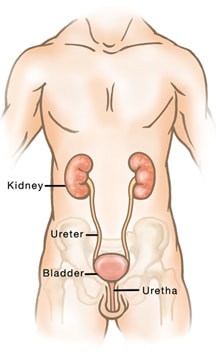
The bladder is a hollow organ in the lower abdomen. It stores urine, the liquid waste produced by the kidneys. Urine passes from each kidney into the bladder through a tube called a ureter. Urine leaves the bladder and exits the body through another tube called the urethra.
As the bladder fills with urine, pressure is exerted on its walls, which you experience as the need to urinate. This triggers the brain to send a message to the layer of muscle that surrounds the inner lining of the bladder, forcing the muscle to contract (tighten) and the urine to flow out of the bladder.
At the same time, the sphincter muscle that surrounds the urethra relaxes, letting the urine flow out of the body. This process requires both nerves and muscles working together to prevent urine leakage. Damage, weakening or injury to either muscles or nerves can result in incontinence.
Incontinence Can Be Caused By
The cause of incontinence and the impact it has on the nerves or muscles will determine the type of incontinence you may have.
- Prostate removal
- Infections or medications
- Diseases
- Urethral strictures
- DESD (Detrusor External Sphincter Dyssynergia)
- Pelvic trauma
- Spinal cord damage
- Multiple sclerosis
- Neurological disorders
Signs of Urinary Incontinence
Do you leak urine when you:
- Cough?
- Sneeze?
- Laugh?
- Bend?
- Lift?
- Change positions (i.e., sitting or lying to standing)?
- Sleep?
Does urine leakage affect your life?
If you answered yes to any of these questions or if you think incontinence is preventing you from enjoying life, talk to your doctor. He can diagnose your type of incontinence and help you find the most effective treatment option.
Jonathan Clavell, M.D., F.A.C.S
Board-Certified Urologist
Jonathan Clavell, M.D., F.A.C.S., is a board-certified urologist and fellowship-trained Sexual Medicine specialist providing advanced men’s health care to patients throughout Houston and the Southwest. He treats a full range of urologic conditions, including erectile dysfunction, BPH, Peyronie’s disease, vasectomy procedures, and complex men’s health concerns.
Dr. Clavell uses advanced minimally invasive and surgical techniques to deliver personalized, patient-centered care. He is also a national and international educator, training surgeons in penile implant surgery, Peyronie’s disease treatment, and Rezūm therapy for BPH, making his practice a trusted destination for specialized urologic care.






Schedule an Appointment with Male Incontinence Specialist Dr. Clavell in Houston, TX
At Clavell Urology, board-certified urologist Dr. Clavell specializes in treating patients suffering from male incontinence in Houston, TX. He will help diagnose your symptoms and discover the best treatment option for you. For more information, contact our office at (713) 424-4030 and schedule an appointment today!